Friday, February 27, 2009

Working girl

Our first project is finished.

Friday my post-mate and myself held a workshop for health workers on HIV/AIDS. Specifically the day was supposed to be a training of trainers to introduce more engaging and interactive community education techniques (think games). This would be a refreshing break from the more routine lecture format or the style of the all-knowing God bequeathing knowledge unto all the mere mortals.

There were some kinks.

Our time-frame (based on the grant we wrote for the project) was short. We didn't pay enough attention to the group dynamics of our trainers (there were four). We were blind-sided by the absolute importance of the chain-of-command in Beninese society (juniors v. elders). Finally, and most importantly, there was the money.

From what we can gather, years ago when "development" first began to be bandyed about as a cure-all for post-colonial/independence crises a prevelant train of thought was that if we just pump money into the situation and step back things will right themselves. This has obviously not worked.

One actual result of this history has been an automatic connection between money and development work. This means that when people are asked to participate in a development meeting/workshop/training one of their first thoughts is how much money they will recieve at the end of it (as in, actual cash handed to them for simply attending). Now this isn't to say that every single person thinks this, just that many people do. And that it was a major problem at our workshop.

Was it a success? A disaster? It was a learning process with growing pains. We're a little wiser for next time, more prepared, ready.
A new school

"Yes?"
"I said, are you watching my hand?"
"Uh, yes.."
"Ok repeat that back to me."
"Ma-iss-moo-ki!"
"What does that mean?"
"It means: what is your name?"
"Right, now let me see how you wrote it.."

The teacher looks over what I had hastily scribbled moments before (I hadn't been paying attention) and claims that I've copied his Arabic script perfectly. I'm not buying it.

I'm in a tin-roofed shack on a hill in the middle of Quran school. The other students are taking an exam while I'm recieving my very first lesson in Arabic. The whole thing was a chance meeting--I was on my way to catch a taxi to Togo when the teacher here stopped me to talk a bit. He asked me to join in and I said of course! After the lesson I agreed to return every Wednesday evening, "we also have class Saturdays and Sundays," he tells me. I'm not that gung-ho I say with a laugh as I go to shake his hand. The teacher smiles uncomfortably, shifts his weight and says, "oh, you know, between men and women...if they're not married we don't really shake hands..." Oh. Right. "Not a problem!" I say laughing at my own blunder, "see you next Wednesday!"

Monday, January 12, 2009

Some Thoughts on the Ever-Accumulating Dust

I'm in Nattitangou writing a grant with my post-mate for an HIV/AIDS education workshop we are hoping to hold in February so I thought I would drop you all a few lines.

Harmattan has begun in earnest. This means that strong winds are blowing in from the northwest, bringing cool, dry weather and Saharan sands with them. In the practical terms of my day-to-day life this translates into very cold mornings, minor respiratory problems, and some of the dirtiest motorcyle rides I have ever experienced (aided and abetted by my entirely visor-less helmet).

Dust is everywhere.

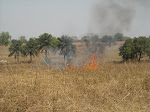
And since we're nearing the heart of the dry season work in the fields has started slowly winding down--in its place controlled brush fires are set to drive out rodents and other animals for young men to hunt down and bludgeon with clubs (my friends have all promised to take me with them one of these days..).

Still in all, a few have predicted rough times ahead. The rains this past year have done quite a bit of damage--from the tearing down of mud-brick buildings and homes to the destruction of needed crops. Coupled with a widespread inaccessibilty to expensive fertilizer has meant a lower overall yield leading some to worry about the approaching scarcity of the dry season.

While very real, such warnings shouldn't be blown out of proportion: I hardly expect a famine. The real crisis is far more gradual and deeply rooted--the daily grind of poverty, made that much more difficult by a few added ecological and economic factors.

Saturday, November 29, 2008

There is Health

There's a very old man who every morning sits under the same tree, wearing the same long robe, with the same walking stick. He sits in the tree's roots like he's reclining in a lazy-boy and every morning we say the same greatings to each other in Lokpa:

Me: Did you wake up well?
Old Man: There is health. Did you wake up well?
Me: Yes, there is health.
Old Man: And your efforts?
Me: There is health.
Old Man: And your husband?
Me: I do not have a husband.

[at this point--and I swear this is every morning--a look of hurt surprise crosses the man's face]

Old Man: And me? Am I not your husband?
Me: No.
Old Man: But we will be married.
Me: No, I do not want to.
Old Man: You do not want to? No, I am your husband.
Me: No.

At this we both burst into laughter, I tell him I am on my way to the health center and we say goodbye--until tomorrow morning when the entire exchange is repeated all over again.

This is a snapshot of what I've been doing for the past three months. Greeting people every single time you see them, no matter if it's the exact same interaction you've both had millions of times before, is so incredibly important here. Its a way of recognizing the presence of others, giving them respect, and cementing your relationship with them. It is something I will be doing for the rest of my service.

In a week I leave for Porto Novo to finish the final two weeks of stage afterwhich (I'm promised) we can begin in earnest whatever projects we might currently be thinking of. My homologue and I have been kicking ideas around like starting a mutual health aid society, a sanitation/trash pick-up campaign, and composting for fertilizer. My postmates and I want to hold information sessions on birth spacing/family planning and sex ed for International Women's Day and we've also begun planning a girl's camp for this summer.

All-in-all I sound pretty busy. Some of these projects may never get off the ground or eventually prove inappropriate or ineffective in my community. And then there's the one or two that really seem to work, that I'll spend the majority of my time on. But there will always be that ever-present, never-ending giant project: greetings. Going out into the village everyday and talking to people. And refusing, every morning without fail, to become the wife of one old man.

Monday, September 22, 2008

Excuse me as I make myself into a liar...

Well, a surprise meeting in Nattitangou (the nearest big "city") has led me to the world wide net so....hello again!

Post is....amazing! Normal day:

Wake up at 7 am (or earlier if I hear the call to prayer around 6), boil water for drinking and for oatmeal, eat and get dressed.
Around 9 or 10 I leave the house (after having done some housekeeping such as washing dishes or doing laundry by hand...) and I start walking around and "saluating."

This is an elaborate process: number one, it's in Lokpa a pretty hard, local language that is really only in this small corner of Benin. Also if I happen to be saying hello to an older person, especially an older man, I am required to crouch down/remain bowing for the entire time which could include such questions as: did you sleep well? did you wake up well? how is the morning/afternoon/evening/night? how are the children? how is your house? how is your work? how is your husband?

This last, when posed to me, is responded with "I do not have a husband." This, without fail, is met with peals of laughter and then wild pointing at the nearest man, or the speaker if he is male (thus indicating that I should marry him). At this I emphatically say "no!" and wag my finger in their face which we both laugh hysterically at for a number of minutes. We then look around at other people, passing animals, baobab trees, and then I say "ok, I'll see you later!" and I move on to the next person to start the entire process over again. This is so incredibly fun!

Life's little essentials:

Water-->I pay a minimal amount for some neighboring girls to bring me pump water which I then have to filter and boil for three minutes before I can drink a glass. Like I said earlier I do laundry by hand once a week, and I take fairly regular bucket showers (i.e. I pour freezing water over my head with a bucket).

Food-->I desperately try to cook edible meals for lunch with varying degrees of success but for dinner I always eat over at some welcoming neighbors' house. The food: something called yam pile (pee-lay) which is DELICIOUS! I'm not sure how to describe it...think of mashed potatoes but the consistency of something akin to clay accompanied with sauces/meats/or cheeses, sooo good!

Buying things-->Market! The big market at a town called Kassua is every Tuesday and it's amazing! Just about everything you could want (ok, no spices really, or vegetables to speak of...and some fruits..but this will change depending on the seasons..) and its chaotic and loud with vibrantly dressed women who want to bargain with you in Lokpa. Fabulous.

Ramadan will end soon and there's going to be a huge party in my village that everyone's going to, but before that I've promised my neighbor that I will "do the fast" with him for one day--no food or water from sunup to sundown, plus praying five times a day....this will be interesting....

End consensus: this is going to be fun.

Wednesday, September 3, 2008

Two Years Left

Well, stage is winding down just as Ramadan begins--everyone here for the most part has passed their French language exams (myself included) and on Friday we all swear-in as real, live Peace Corps Volunteers!

Looking back, these past nine weeks have flown by, even if it feels like we havent really done all that much (this according to my 'normal' coneption of what constitutes work...but let me just say that holding intelligent conversations in a second or third language is incredibly hard work, thank you very much). On Sunday I leave for post and for the next three months we are all mandated to remain there as a sort of lock-down, hard core integration, sink-or-swim sort of deal. This is both exciting and terrifying but in reality its sort of like a 24 hour hang-out bonanza. This will also mean that I wont have internet access until basically December so if youd like to know whats up, call my parents (also if you would like to call me directly, get the info from my parents: 269.651.3833).

Post visit was really fun--the area is *gorgeous,* I met a few of the people who work at the health center and I had a long conversation about development, poverty, and slavery with one of my neighbors who also happens to be a zemidjan (motocycle taxi driver person). So that was pretty great. Also I have some fantastic post mates, just an excruciating bike ride away, and a fairly decent cement house given that it has no electricity or running water.

Im about to run out of time here so I guess I'll write again in December as an actual volunteer!

p.s. Sending me stuff: please do:) apparently that first address I posted is the final one so use that...also if you want to add some religious warnings on the package to discourage theft that can never hurt (write: 'Dieu vous regarde' which means 'God is watching you'). Ang, about sending me money probs not a good idea just because it could get lost and I dont want to deal with exchanging it and I get enough cheese as it is, but thanks for the thought!

p.p.s. visiting me: if you are so inclined and have the extra cash please do:)!!! Just talk to me about it so we can plan way ahead of time. I would love to see any one of you out here, let me know!

Monday, August 11, 2008

Tu es enceinte?

Sample interaction (in user friendly English):

Beninese woman: Are you pregnant?
Me: No, no Im not.
Woman: So why is this fat? (points to my stomach)
Me: Uh..I just ate...

Besides that delightful conversation, last Saturday I helped kill a chicken (which we then plucked, cooked, and ate) and yesterday my papa took me and two other stageaires to his home village to "walk" around and say hi to people. In actuality this same village is flooded for three months out of the year so we ended up boating around on small, slim vessels called pirogues.

Ive found out my post, its a small village in the northeast, close to Togo. I am replacing another volunteer who did a lot of work in building latrines, weighing babies, and community education. I will have no running water or electricity, and the local language is Lokpa (gna nelim--good afternoon). Next week we all go to our posts to check everything out, meet with our Beninese counterparts, and see what we need to buy in terms of furnishings. Then its just two more weeks till swear-in and we all become actual Peace Corps volunteers (insert the exclamation point that I cant find here)