Thursday, March 11, 2010

Experiments in Heat Evasion

February saw the beginning of my least favorite (though aptly named) Beninese season--Chaleur or "Heat." This means that by 10 a.m. the sun's immense power is already bearing down on all of us, slowing everyday life to a crawl as we all sluggishly amble between patches of shade. Wells have dried up to such an extent that the water pulled up is completely opaque with sand and dust. Most men simply lounge under trees all day and alternate between board games and heat-induced comas.

For me the season officially announced itself when one day I walked into the concrete box I call home and instantaneously broke into an all-over body sweat. Now if I stay stationary for too long at home around noon, little puddles of perspiration collect around my feet. This unfortunate situation poses a serious problem when nighttime rolls around and I’d like to get some sleep. Against my will I’m awakened--sometimes three times a night--by the dampness (read: saturation) of my sheets forcing me onto my feet and to the shower to pour water over myself.

It was my Beninese mama who first suggested sleeping on the floor. This worked wonderfully for a few nights (except for a little soreness) until one morning I opened a work folder to discover a pre-historic centipede about four inches long. Her son was later stung by a scorpion who escaped his suffocatingly hot hiding place for just that purpose. I moved back to the bed.

Another village friend advised me to get a cot made. In Benin cots are surprisingly comfortable wood-and-tough-plastic-bag affairs so it seemed like a viable option. I got one and slept on it one night: heaven. On the second night an unfortunate miscalculation in terms of body mass and centers of gravity resulted in the collapse of my cot and a very bruised and hurting elbow. I’ve moved back to the bed.

Though I still haven’t admitted defeat in my efforts to reduce my nightly sweat output, there is definitely a light at the end of the tunnel. Chaleur only lasts until around the beginning of April and then--after months and months--come the rains. And that’s when the best season of all begins: Mango Season.

Saturday, February 13, 2010

Care Groups

In a previous post I described the inauguration in my village of Care Groups, a project designed to train local women as peer educators of simple preventative health messages.


Let me bring you up to speed.


Since then the three Care Groups I work with have had six monthly meetings covering topics such as handwashing, breastfeeding, and nutrition. Adjara my workpartner (an aid at the Health Center) and I try hard to make these meetings as interactive and fun as possible for the women with pictures, puzzles, songs, and more. Between meetings the women are supposed to make home visits so that they can then in turn teach what they learned to other families and in so doing reach a much wider audience in a faster and more effective manner. Last week I met with one of these groups:


Early last Friday morning Adjara and I arrived at our meeting place under a mango tree and waited for the women to come. One by one they assembled, some carrying stools and others benches for sitting, all sporting their matching t-shirts proclaiming them to be "Leader Mothers." Once everyone was there I formally greeted the group and asked about the previous month's home visits. I also asked about certain "critical information" such as new births, deaths, sicknesses, etc., in order to pinpoint problem areas as well as to simply gather community data.


After this Adjara and I discussed with the women our findings from a census we conducted a few months back. For the census we asked a sampling of households about hygiene and sanitation, mosquitoe net usage, breastfeeding, and more general statisitics like the number of children, up-to-date vaccinations, and pregnancies per woman. In order to present this information to the women we decided to draw pictures to represent each number and put tally marks next to it. So, for example, we had a drawing of a sick man with nineteen tally marks, that meant that nineteen illnesses were reported to us when we conducted the census. Once every picture was explained in this manner I asked the women to tell me first what was positive and then what they wanted to see change in their community. In that way they were able to set goals for themselves for the coming six months, goals we will be able to evaluate once we conduct the exact same census in August.


We then reviewed malaria--where does it come from, how can you prevent it, and how do you treat it. Since right now is the halfway point of the project we've started to go back over everything we've already covered to really make sure the women know their stuff. And they did: we quizzed them individually and at random and they all passed with flying colors, topping it all off by singing a song about malaria in Lokpa.


What is so great yet frustrating about this project is its decentralization--we try very hard to put as much power in the women's hands as possible, with varying degrees of success. For the group I've just described this has meant a wonderful show of initiative and motivation to the point where group members keep track of meeting dates, work in pairs, and form a cabinet to help with the overall organization of the group. For the other groups this hasn't always been the case. One in particular has consistently struggled with meeting times (members are almost always more than three hours late), meeting dates (we've had to reschedule three meetings), and attendance in general (twice more than half the group never even showed up).


To adress these problems Adjara and I called a village-wide meeting where we explained the goal of the project and the difficulties we've been having. We didn't quite get the demographic range we were hoping for (the meeting was made up predominanty of women) and the village chief didn't show up until the end. Regardless the women recommitted themselves to the project and promised to work harder--but as their next meeting isn't until next Friday it remains to be seen what changes if any they will actually make.


Despite hiccups like this the overall project has been wonderful and the women seem really motivated to help change their communities. I'm worried about the future and whether or not Care Groups will continue after I leave in September but even before that day comes we all still have a lot of work ahead us. And I for one can't wait to see what these women will do.

Sunday, December 6, 2009

A Slice of Beninese Life

Last week's yellow fever vaccination campaign provided an interesting window on life in Benin.

Vaccination campaigns (concerning various illnesses) happen periodically throughout the year all across the country. They are great favorites with the workers at my health center since, unlike their monthly salaries, a paycheck is a sure thing at the end of them (as they recieve outside funding, such as WHO, and not from the Beninese government). Each health center keeps a group of vaccinators on the ground while at the same time sending teams of vaccinators out into villages farther away from the center itself. This "agressive strategy" is meant to reach the greatest number of people possible within the time constraints of the campaign.

I was part of the team that stayed at the health center. There were four of us: only one spoke the local language and only one, but not the same one, actually vaccinated; the rest did paperwork. We were all women, something that the head doctor initially objected to. He said he didn't want a team with only women since it was inevitable that "they would fight." You know women and their hysterics.

I mentioned paperwork. The Beninese have an on-going never-ending love affair with paperwork. Anything that is smothered in legalese, stamped, and signed several times is bound to be framed and hanging in any respectable Beninese home. Everyone vaccinated was given a card with their personal information (and an official stamp) and my job was to check them off in the appropriate age group. When I help with pre-natal consultations during the week I shuffle through four different notebooks along with various charts and booklets in a hurried scramble to get everyone's information copied down, usually in triplicate.

And who is all this paperwork prepared for? The all-powerful patron--in our case the head doctor. Patrons or head bosses strike fear in the hearts of their underlings with regular check-up visits in which they rarely fail to find at least one thing wrong, no matter how trivial (think: amount of leaves on the ground). Reprimands for such errors are usually stern and are often aimed to humble and humiliate. In the case of vaccination campaigns this translates into extra care in groundskeeping, a halt to charging phones with the center's generator (used to power the vaccine's refrigerator), and frequent fudging of numbers on all that paperwork in case of any unaccounted or left over doses. What the patron doesn't know can't reflect badly on you.

Finally there's the vaccination process itself. Everything starts off fine, it's dry season now so the mornings are quite cool and everyone is ready for the day's work. The nurse actually vaccinating and I have set up inside the consulting room of the maternity, the two other women are outside dealing with paperwork. Anyone and everyone is supposed to be vaccinated, nine months and up (one shot good for ten years). I am given the seemingly simple task of checking people off based on age groups--problems quickly crop up. A lot of people simply don't know their age. Others, mainly students, give fake ages--the age they use in school. It seems that the Beninese school system has an age limit, so once you pass that you're no longer allowed in. Therefore those who have previously dropped out or who never went in the first place and who are already too old will lie and say they're younger so they can go to school. Thus the full-grown man sporting a beard whose towering over me and claiming he's twelve.

The nurse vaccinating has begun the day fairly good-humored and jokes with the villagers who have come to be vaccinated. As the day wears on and the sun climbs higher however, her cheerfulness flags. It becomes hot, very hot, and the burning sun starts to bake the dead rat that's been in the ceiling for days. It stinks. We've already vaccinated over six hundred people and the nurse is no longer joking--she's irritated. Children from the primary school across the street have lined up and after the tenth one in a row who hasn't rolled up his shirt sleeve in preparation for the shot the nurse starts dealing out slaps to the tops of heads. Needles are waved about and nurses are screaming at everyone. Eventually things do slow down and, regaining her former good humour, the nurse tries a joke or two, adding a few racial slurs for good measure. Once during the course of our regular, weekly vaccinations I saw a health worker slap the face of a young mother who hadn't restrained her child properly while she was gettting a shot. The doctor-patient relationship we enjoy in the states is almost unimaginable here.

That first day of the campaign we vaccinated eight hundred men, women, and children against yellow fever. Afterwards I went home, cooked dinner, and read a book before falling asleeep. A (fairly) typical day in Benin.
Sunday, November 8, 2009

A Letter of Appreciation to My Mama

Just about every volunteer (at least in Benin) has a mama. Often she's a neighbor; sometimes she's just a good friend. Sometimes she speaks French while others only know the local language. She's the one that gives you massive amounts of food and scolds you when you can't even finish half. She always offers to do your housework for you (and maybe she actually does) and she's terrified when you're sick. She knows all the best food sellers, clothes sellers, any kind of seller, and will tell you the right price. Maybe she'll even help you barter. In short she's a godsend, a life-line, a source of support. And because my mama is all this and more, here's a letter to her in my local language:

Mama--

Thank you. Thank you for befriending me from the very first moment when you walked up to my front door and asked to chat for a bit because you felt lonely. Even then it was easy to talk to you (especially since you speak French) but also because you treat me like anyone else. Instead of seeing me as an opportunity (i.e. for money or free things) you see me as another woman, another villager who you can talk openly with about anything. And we do talk about everything--how you were circumcised, spousal abuse, the fact that not all Americans are white, your fear of small animals (which is weird by the way). Thank you for laughing at me and with me. Thank you for helping me learn Lokpa. Thank you even for your only son who at four years is possibly the biggest brat I have ever met (think Dennis the Menance to the fiftieth power). Thank you for cooking me dinner for the better part of a year and for having the good grace to accept it when I started cooking for myself after two bouts of ameobas. And thank you most of all for all those conversations under the stars before we both go to bed (early!) and for all those conversations yet to come. You are my biggest support and best friend in village. Thank you,

Heidi (Aicha)

Tuesday, September 1, 2009

I am Huge and You Can't Judge Me!

After working for two weeks with the newly arrived trainees, I decided to take a few vacation days to visit a friend here in the South. She lives in Aja-land where the tropical heat and especially the humidity means that a simple walk down the street can trasnform the clothes on your back into sopping sweat-rags. It also means that the vegetation down here is a vibrant green that grows in thick, tangled masses all over the place. Driving out to her post I passed satuarated marshlands and lakes with stilt houses growing out of the still water. Often the grass hanging over the side of the road was taller than a grown man, a fact that did not affect the speed of cars and motos (i.e. breakneck) even when the road became very curvy.

Catherine, my friend, lives in a medium-sized town complete with several paved roads, electricity, and running water. Here in Aja-land everything is loud. And it's not just the constant flow of taxis and motos that screech and honk incessantly. It's the people who yell and scream and holler at each other and you and everyone. But they're not angry--not all of the time--this is just how people are here, how they express themselves. "Yovo" was sung/shouted at us constantly.

Mostly we stayed in her cozy house where we cooked (fabulous meals of Hamburger Helper, carrot cake, and pigs in a blanket!), and watched movies on her lap-top. We did make one expedition however, to see the local hippopotamuses (or hippopotami?). There are two of them--a mother and her four year old--who live in a nearby lake and for the price of 3000FCFA ($6?) you can rent a pirogue (think: canoe) and see them. Definitely worth it.

To begin we took motos to a nearby village where a pack of children met us and, instantly knowing what we wanted, led us to the house of the hippo guide. After some paperwork and payment our guide led us through the village to the lake. Barefoot, he walked swiftly down a winding path that cut through the encroaching brush while we struggled to keep up. Two smaller children carried our moto helmets, also outstripping Catherine and I.

Once at the water's edge we were told to wait while the guide got the canoe ready. Soon we heard the sound of the small children bailing out water; our canoe, it seems, was a bit leaky. Once most of the water had been dumped out we got in and our guide, pushing the ground with a long stick, deftly manoeuvered us through a tight inlet and onto the lake itself. The lake was wide and calm and ringed with leafy, green vegetation.

We drifted towards the center for a bit, occasionaly asking questions of our guide. At one point a fisherman at the other end of the lake yelled something and we changed directions. Catherine and I supposed that he had said something like, "the hippos are over here!" Soon we saw the ears and the top of the head of one of the hippos, the mother. At a distance we could see her head out of the water and we could see that she saw us. Then she ducked under for several minutes at a time before resurfacing at a point closer to us. Our guide and the children bailing out water drove the canoe into the nearby bank. A few low, staccato grunts sounded from the bushes somewhere to the right of where we waited. The child was calling to its mother. Then they were both in the water, swimming in circles around each other while we watched. After awhile we shoved off, lazily drifting towards our starting point, all the while still watching the hippos. For a time the child followed us but he quickly gave up. The sun was setting and the temperature was cooling off--almost time for the hippos to go on land and feed.

We asked if the locals had given the hippos names. "Yes," said our guide, "they are called 'I AM HUGE AND YOU CAN'T JUDGE ME!"

Thursday, July 16, 2009

Yoga, sex, and an ambulance

What happens when you put sixty Beninese (teenage) girls, seven Peace Corps volunteers, and matching t-shirts all together in a semi-cramped yet wonderfully available tissage center? Girls Camp! That's right: one full week of group discussions, defining objectives, sports (think: dodgeball!), learning computer skills, talking about sex, games, and camp songs sung at ear-piercing levels in French.

The highlights for me? Firstly I led the yoga session in our "Managing Stress" segment. It seemed to go over fairly well although space was limited, the girls were giggly, and the idea that it was not supposed to hurt didn't quite carry itself across. Secondly, after having a head maternity nurse come in to answer any questions pertaining to reproductive health we realized that most of them didn't even have the basics down (e.g. what is a uterus? why do women menstruate? etc.). In fact that information isn't given out until the 3eme grade--which is roughly equivalent to freshman or sophomore year of high school. Our girls were more like middle school. So, Rut (my postmate, also a health volunteer) and I quickly drew up some matter of fact diagrams of a naked woman and man, explained the uterus and menstruation, the mechanics of sex, and different methods of contraception. Afterwards everyone said that our talk was a lot clearer for the girls and that they were all very interested in what we had to say.

Talking about sex...I've been asking around in my village and the end consensus is that people don't. Parents especially almost never talk to their kids about sex, although they complain quite often and loudly that the youth of today have no morals and its all they think about. This unfortunate taboo goes for other subjects as well, such as menstruation. In a culture where you learn not by asking questions but by silently watching and copying, finding out about such topics becomes a little tricky; some things you just can't observe. A further complication: as I mentioned above the "sex talk" isn't delivered in school until about high school at which point kids are given a run-through of human anatomy and the barest sketch of the other stuff. In most cases this is way too little way too late since, especially in smaller villages like my own, many if not most girls drop out of school long before the 3eme and many are already having sex. In a situation like that, with no one to tell you any different, who knows what sort of explanation you might come up with on your own...

After the camp I was looking forward to a few days of relaxation and then of preparation for some upcoming Care Group meetings. Not so. The very last day I woke up with a splitting headache that refused to go away. Once home I tried eating something to see if that wouldn't help things a bit...I threw it up. Then I threw up water and was dry-heaving. I had a fever. I called the Peace Corps doctor who wanted me to spend the night at the health center so I wouldn't be alone. One terrible night later an ambulance was called in from Parakou that took both myself and Rut (as moral support) down to Cotonou. After having an IV the entire way down I felt a lot better and quickly recovered in the days that followed. The doctor thought I had malaria even though it didn't show up in the blood test. But I might just tell people I did...malaria sounds much more interesting than the flu.

Tuesday, June 9, 2009

Rain on a tin roof makes a very loud noise

Rainy season is finally here again, just as the mangos have started to dwindle. Everything grows so fast here--I went down to Cotonou for a week-long workshop and when I came back all the previously brown and dying shrubs had somehow been replaced by thriving, green, knee-high vegetation! It was like the whole landscape changed overnight, like it took a really great (non-bucket) shower.

This has also meant a return to the fields for many villagers (some never really left off). Now instead of the gangs of men lounging around playing board games all day I seem them starting off into the "bush" early in the morning--wearing their worn work clothes and broad-rimmed straw hats, carrying machetes and hoes. For the women, who never stop working (and certainly do not play board games), this just means a new task to shoulder along with all the rest.


Lately I've been trying to start up what are called "Care Groups." This means selecting a group of Leader Mothers (about ten) and holding monthly meetings with them about certain topics like malaria, sanitation, or malnutrition. Then the Leader Mothers go out into the village to relay the same message to other mothers and report back at the next meeting. Our first real meeting was a few days ago, the women had a blast even though it hadn't gone exactly as I'd planned. I had wanted them to draw a community map to sort of envisage for themselves their village. They wanted to actually go house to house and talk about malaria (a topic we had discussed in a previous meeting [we, including me, sang a song for them in Lokpa!]). We went house to house. There were a few problems but, like I said, the women absolutely loved it. And as long as they do I have no problem at all with changing my plans around.

Saturday, April 25, 2009

Homecoming

I came back to post after traveling a bit for some Peace Corps functions to find my little Beninese village flooded with people. Loud music emananted out of "downtown" and the streets were so choked with human beings my zemidjan was hard pressed just to drop me off at the house. Looking around I saw large, loud women dressed to the nines in colorful matching outfits with outlandish headwraps, invading the surrounding airspace at odd angles. A brass band errupted into noise and rythm with abandon. A voice from deep within the ever-expanding crowd was struggling with a microphone and the touchy, generator-fueled technology that supported it. A fete (festival) was in full swing.

I had been waiting for this particular fete almost since I first arrived back in September and was ecstatic that it had finally come. This, I knew, would be a full week-long fiesta in which every current and past resident of the village returns to party, dance, and discuss the community's future development. But mostly to party.

The result was often a strange mix: young men returning from bigger cities like Parakou, Cotonou, or even Niamey had come back sporting corn-rows and long, silver chains with "50cent" medallions. They looked more like American youths coming back from a concert in comparison with the shaven village boys who wore worn, hand-me-downs bought at the local market. Returning women exuded wealth with their elaborate outfits, hairstyles, and manicures, and men with flashy new motorcycles and cellphones. I heard French more and more, and was called "yovo" so much it felt like the past eight months had been erased and I had just stepped off the plane.

Each regional group (e.g. all those returning from Cotonou) had prepared their own unique dance which was performed for the crowd throughout the week. When a dancer was thought to be good, candy was stuck to their forehead--when they were really good, money. Here again was an opportunity to display one's success and accumulated wealth in the difference between a 25 franc piece, 500 franc piece, or 1.000 franc paper bill that one plastered across the forehead of a particular dancer. At night when the performances were finished the youths took over, blasting popular music and dancing until all hours of the night.

During the day the elders held meetings to discuss the village's development. Held "downtown" under the mango and baobab trees, these meetings were often large and predominantly male (I never saw more than three women present, myself included). Ideas were presented, and grievances expressed. The progress on the new school being built just outside the village limits was reported as well as the past year's expenditure for the local village association (who hosted the fete). Generally, it was the local residents who did most of the talking.

The entire week the village was charged with an electric energy--the village was full, things were happening, people were happy. This carnival atmosphere sustained itself until Saturday. On Sunday everyone was gone; the village was empty again. Slowly, almost like a deflated balloon, villagers took up their old posts and jobs again and began to live the quiet, normal life they had briefly left during the fete.

I found out afterwards that the fete made national television--complete with several shots of the local American dancing along with the best of them.

Friday, February 27, 2009

Working girl

Our first project is finished.

Friday my post-mate and myself held a workshop for health workers on HIV/AIDS. Specifically the day was supposed to be a training of trainers to introduce more engaging and interactive community education techniques (think games). This would be a refreshing break from the more routine lecture format or the style of the all-knowing God bequeathing knowledge unto all the mere mortals.

There were some kinks.

Our time-frame (based on the grant we wrote for the project) was short. We didn't pay enough attention to the group dynamics of our trainers (there were four). We were blind-sided by the absolute importance of the chain-of-command in Beninese society (juniors v. elders). Finally, and most importantly, there was the money.

From what we can gather, years ago when "development" first began to be bandyed about as a cure-all for post-colonial/independence crises a prevelant train of thought was that if we just pump money into the situation and step back things will right themselves. This has obviously not worked.

One actual result of this history has been an automatic connection between money and development work. This means that when people are asked to participate in a development meeting/workshop/training one of their first thoughts is how much money they will recieve at the end of it (as in, actual cash handed to them for simply attending). Now this isn't to say that every single person thinks this, just that many people do. And that it was a major problem at our workshop.

Was it a success? A disaster? It was a learning process with growing pains. We're a little wiser for next time, more prepared, ready.

A new school

"Yes?"
"I said, are you watching my hand?"
"Uh, yes.."
"Ok repeat that back to me."
"Ma-iss-moo-ki!"
"What does that mean?"
"It means: what is your name?"
"Right, now let me see how you wrote it.."

The teacher looks over what I had hastily scribbled moments before (I hadn't been paying attention) and claims that I've copied his Arabic script perfectly. I'm not buying it.

I'm in a tin-roofed shack on a hill in the middle of Quran school. The other students are taking an exam while I'm recieving my very first lesson in Arabic. The whole thing was a chance meeting--I was on my way to catch a taxi to Togo when the teacher here stopped me to talk a bit. He asked me to join in and I said of course! After the lesson I agreed to return every Wednesday evening, "we also have class Saturdays and Sundays," he tells me. I'm not that gung-ho I say with a laugh as I go to shake his hand. The teacher smiles uncomfortably, shifts his weight and says, "oh, you know, between men and women...if they're not married we don't really shake hands..." Oh. Right. "Not a problem!" I say laughing at my own blunder, "see you next Wednesday!"

Monday, January 12, 2009

Some Thoughts on the Ever-Accumulating Dust

I'm in Nattitangou writing a grant with my post-mate for an HIV/AIDS education workshop we are hoping to hold in February so I thought I would drop you all a few lines.

Harmattan has begun in earnest. This means that strong winds are blowing in from the northwest, bringing cool, dry weather and Saharan sands with them. In the practical terms of my day-to-day life this translates into very cold mornings, minor respiratory problems, and some of the dirtiest motorcyle rides I have ever experienced (aided and abetted by my entirely visor-less helmet).

Dust is everywhere.

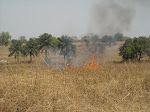
And since we're nearing the heart of the dry season work in the fields has started slowly winding down--in its place controlled brush fires are set to drive out rodents and other animals for young men to hunt down and bludgeon with clubs (my friends have all promised to take me with them one of these days..).

Still in all, a few have predicted rough times ahead. The rains this past year have done quite a bit of damage--from the tearing down of mud-brick buildings and homes to the destruction of needed crops. Coupled with a widespread inaccessibilty to expensive fertilizer has meant a lower overall yield leading some to worry about the approaching scarcity of the dry season.

While very real, such warnings shouldn't be blown out of proportion: I hardly expect a famine. The real crisis is far more gradual and deeply rooted--the daily grind of poverty, made that much more difficult by a few added ecological and economic factors.

Saturday, November 29, 2008

There is Health

There's a very old man who every morning sits under the same tree, wearing the same long robe, with the same walking stick. He sits in the tree's roots like he's reclining in a lazy-boy and every morning we say the same greatings to each other in Lokpa:

Me: Did you wake up well?
Old Man: There is health. Did you wake up well?
Me: Yes, there is health.
Old Man: And your efforts?
Me: There is health.
Old Man: And your husband?
Me: I do not have a husband.

[at this point--and I swear this is every morning--a look of hurt surprise crosses the man's face]

Old Man: And me? Am I not your husband?
Me: No.
Old Man: But we will be married.
Me: No, I do not want to.
Old Man: You do not want to? No, I am your husband.
Me: No.

At this we both burst into laughter, I tell him I am on my way to the health center and we say goodbye--until tomorrow morning when the entire exchange is repeated all over again.

This is a snapshot of what I've been doing for the past three months. Greeting people every single time you see them, no matter if it's the exact same interaction you've both had millions of times before, is so incredibly important here. Its a way of recognizing the presence of others, giving them respect, and cementing your relationship with them. It is something I will be doing for the rest of my service.

In a week I leave for Porto Novo to finish the final two weeks of stage afterwhich (I'm promised) we can begin in earnest whatever projects we might currently be thinking of. My homologue and I have been kicking ideas around like starting a mutual health aid society, a sanitation/trash pick-up campaign, and composting for fertilizer. My postmates and I want to hold information sessions on birth spacing/family planning and sex ed for International Women's Day and we've also begun planning a girl's camp for this summer.

All-in-all I sound pretty busy. Some of these projects may never get off the ground or eventually prove inappropriate or ineffective in my community. And then there's the one or two that really seem to work, that I'll spend the majority of my time on. But there will always be that ever-present, never-ending giant project: greetings. Going out into the village everyday and talking to people. And refusing, every morning without fail, to become the wife of one old man.

Monday, September 22, 2008

Excuse me as I make myself into a liar...

Well, a surprise meeting in Nattitangou (the nearest big "city") has led me to the world wide net so....hello again!

Post is....amazing! Normal day:

Wake up at 7 am (or earlier if I hear the call to prayer around 6), boil water for drinking and for oatmeal, eat and get dressed.
Around 9 or 10 I leave the house (after having done some housekeeping such as washing dishes or doing laundry by hand...) and I start walking around and "saluating."

This is an elaborate process: number one, it's in Lokpa a pretty hard, local language that is really only in this small corner of Benin. Also if I happen to be saying hello to an older person, especially an older man, I am required to crouch down/remain bowing for the entire time which could include such questions as: did you sleep well? did you wake up well? how is the morning/afternoon/evening/night? how are the children? how is your house? how is your work? how is your husband?

This last, when posed to me, is responded with "I do not have a husband." This, without fail, is met with peals of laughter and then wild pointing at the nearest man, or the speaker if he is male (thus indicating that I should marry him). At this I emphatically say "no!" and wag my finger in their face which we both laugh hysterically at for a number of minutes. We then look around at other people, passing animals, baobab trees, and then I say "ok, I'll see you later!" and I move on to the next person to start the entire process over again. This is so incredibly fun!

Life's little essentials:

Water-->I pay a minimal amount for some neighboring girls to bring me pump water which I then have to filter and boil for three minutes before I can drink a glass. Like I said earlier I do laundry by hand once a week, and I take fairly regular bucket showers (i.e. I pour freezing water over my head with a bucket).

Food-->I desperately try to cook edible meals for lunch with varying degrees of success but for dinner I always eat over at some welcoming neighbors' house. The food: something called yam pile (pee-lay) which is DELICIOUS! I'm not sure how to describe it...think of mashed potatoes but the consistency of something akin to clay accompanied with sauces/meats/or cheeses, sooo good!

Buying things-->Market! The big market at a town called Kassua is every Tuesday and it's amazing! Just about everything you could want (ok, no spices really, or vegetables to speak of...and some fruits..but this will change depending on the seasons..) and its chaotic and loud with vibrantly dressed women who want to bargain with you in Lokpa. Fabulous.

Ramadan will end soon and there's going to be a huge party in my village that everyone's going to, but before that I've promised my neighbor that I will "do the fast" with him for one day--no food or water from sunup to sundown, plus praying five times a day....this will be interesting....

End consensus: this is going to be fun.

Wednesday, September 3, 2008

Two Years Left

Well, stage is winding down just as Ramadan begins--everyone here for the most part has passed their French language exams (myself included) and on Friday we all swear-in as real, live Peace Corps Volunteers!

Looking back, these past nine weeks have flown by, even if it feels like we havent really done all that much (this according to my 'normal' coneption of what constitutes work...but let me just say that holding intelligent conversations in a second or third language is incredibly hard work, thank you very much). On Sunday I leave for post and for the next three months we are all mandated to remain there as a sort of lock-down, hard core integration, sink-or-swim sort of deal. This is both exciting and terrifying but in reality its sort of like a 24 hour hang-out bonanza. This will also mean that I wont have internet access until basically December so if youd like to know whats up, call my parents (also if you would like to call me directly, get the info from my parents: 269.651.3833).

Post visit was really fun--the area is *gorgeous,* I met a few of the people who work at the health center and I had a long conversation about development, poverty, and slavery with one of my neighbors who also happens to be a zemidjan (motocycle taxi driver person). So that was pretty great. Also I have some fantastic post mates, just an excruciating bike ride away, and a fairly decent cement house given that it has no electricity or running water.

Im about to run out of time here so I guess I'll write again in December as an actual volunteer!

p.s. Sending me stuff: please do:) apparently that first address I posted is the final one so use that...also if you want to add some religious warnings on the package to discourage theft that can never hurt (write: 'Dieu vous regarde' which means 'God is watching you'). Ang, about sending me money probs not a good idea just because it could get lost and I dont want to deal with exchanging it and I get enough cheese as it is, but thanks for the thought!

p.p.s. visiting me: if you are so inclined and have the extra cash please do:)!!! Just talk to me about it so we can plan way ahead of time. I would love to see any one of you out here, let me know!

Monday, August 11, 2008

Tu es enceinte?

Sample interaction (in user friendly English):

Beninese woman: Are you pregnant?
Me: No, no Im not.
Woman: So why is this fat? (points to my stomach)
Me: Uh..I just ate...

Besides that delightful conversation, last Saturday I helped kill a chicken (which we then plucked, cooked, and ate) and yesterday my papa took me and two other stageaires to his home village to "walk" around and say hi to people. In actuality this same village is flooded for three months out of the year so we ended up boating around on small, slim vessels called pirogues.

Ive found out my post, its a small village in the northeast, close to Togo. I am replacing another volunteer who did a lot of work in building latrines, weighing babies, and community education. I will have no running water or electricity, and the local language is Lokpa (gna nelim--good afternoon). Next week we all go to our posts to check everything out, meet with our Beninese counterparts, and see what we need to buy in terms of furnishings. Then its just two more weeks till swear-in and we all become actual Peace Corps volunteers (insert the exclamation point that I cant find here)

Monday, July 21, 2008

A Long Post, or My Beninise Life So Far...

The other day my host papa drove me to "class" in sheets of rain, so much so that it made the dirt roads nearly impossible to navigate, all the more because his car is equipped with non-functioning wind shield wipers. Then--in the middle of the road--we stopped. "C'est fini" he says. We've run out of gas. So, he goes to look for some telling me to wait in the car. But don't worry, all was safe--the Beninois know better than to go out in the rain...funny that...Fifteen minutes later he returns--drenched--with gas, we laugh for a bit, and continue on our merry way. C'est la vie.

Well, despite (or because of?) such minor incidents as the above and the daily bike ride of terror, complete with goat-dodging, I'm loving every minute of life the Beninese way. Stage (pronounce this with your best French accent) is going great--today we weighed some babies at a village just outside of Porto Novo and this weekend we're going to Ouidah to visit a Python Temple.

My host family is amazing I currently live in a baller house (just as nice as anywhere in the US except for no running water--bucket showers anyone?) My mama is a diva hairdresser who claims that I don't eat well (or at all in her opinion) and my papa, as you can already, tell is pretty much awesome. There are ten children in the house ranging from 2 to 23, although it is not clear if they're all from the same mother or even biologically related.

Regardless, we pass the time by watching tv (yay for spanish soap operas) and dancing to Akon, Akon, more Akon, and maybe some Michael Jackson if I'm lucky. So in summary, I'm happy, I'm healthy, and I'm terrified to be doing this on my own au village. But hey--I've got two years to figure it out...

Monday, July 7, 2008

Just Another Day in Cotonou...

So we arrived fairly on time in Cotonou (a large port city in southern Benin) on the 4th to a massive, living, breathing monster that was the Cotonou Airport baggage claim. Two hours later we entered St. Jean Eudes, a Jesuit/missionary/convent school thing where we're staying until Wednesday afternoon. So far we've been doing a lot of orientation, collecting needed essentials (e.g. bikes and helmets), and beginnning French classes.

Cotonou itself is incredibly chaotic, loud, and dirty--there's tons of pollution. Also, of course, traffic here is insane especially with thousands of zemijdans (motorcycles) zipping in and out of cars and trucks, apparently immune to traffic rules (if there are any). On Wednesday we leave for the capital, Porto Novo, where we'll meet our host families and really begin training. I can't wait!

Quickly: toilets are all squat, I've already had to take a bucket shower (since water and electricity cut out frequently at St. Jean Eudes, and the food is pretty good!)

Thursday, July 3, 2008

Staging!

Does anyone know why they call two days of orientation "staging"? This remains a mystery for me. Regardless, it's already over--the past two days have been packed with awkward ice breakers, group projects, and self- and "official" terms and definitions. But despite all that, I immediately felt at home here, everyone is a blast and what's more they're not what I expected. Of course, there are representatives of the "traditional" Peace Corps volunteer (think...hippie...) but no one fits exactly into any one box or category, I love it. Tonight we went to an amazing sushi place then on to just a local bar..I wish we had more time to explore Philly but I suppose we have bigger fish to fry. Tomorrow we get malaria medicine then catch a flight to Charles de Gualle at 6pm. As my last night in America for two years, I have to say that this was a pretty good one. The next one will be in Cotonou, Benin!

Tuesday, July 1, 2008

Nuts and Bolts...

forgot to mention: my mailing address in Benin for the first few months will be:

Heidi Kershner, Peace Corps Volunteer
Corps de la Paix
B.P.971
Cotonou, Benin

Feel free to mail me stuff...it may take a while to get to me but that's alright. Also, if you're thinking of sending care packages make sure that they're not too heavy..it's expensive to pick them up from the post office!

Also, a word about this blog--I've included on the right some links to a wiki I created with just a few facts about Benin and Africa in general (some of it is a little on the ranting side), and pictures. I have a link to Benin pictures, I'll try to update that as much as possible but who knows what that'll be like..I also included pictures from my trip to Tanzania last summer (for the benefit of relatives without facebook!). Enjoy:D

Monday, June 30, 2008

Leaving on a jet plane..

So as of last Wednesday—when summer classes ended—I am officially no longer an undergraduate at Michigan State, and am now well on my way towards acquiring (as one gentleman I know put it) “more degrees than a thermometer.” But since on-line courses are…on-line…I’ve actually spent the majority of the last two months alternatively watching the Golden Girls (the best show ever made) and trudging through the free Rosetta Stone trial the Peace Corps provides like I was storming the beach at Normandy. Soon however all that excruciating language learning will be put to good use since in just a few short days I will be flying out to serve for two years in Benin, West Africa. Staging, a sort of orientation deal thing, is going to be held in Philadelphia and will last for two days before we fly out for Paris then Cotonou on the 4th. Right now they’ve said that my position will be one of several “community health advisors” (delightfully vague…) and once we arrive, me and the other trainees will be paired with host families and undergo training until September. And that’s for the most part all I know—Peace Corps loves to keep you on your toes and guessing!

Everyone has been asking lately how I feel about going and if I'm excited or not...I always answer with something like "up and down" or "sometimes excited and other times scared out of my mind." But mostly I think I feel ready--to see what's going to happen, what it will be like, and what I'll do. Anyway, I hope you'll follow along (I promise not to be too christmas newsletter-y) and feel free to email my parents at
tkershner@charter.net or me at hkershner@gmail.com with questions or whatever (although I can't promise I'll get back to you in any sort of a timely manner)! And thank you so much to all my friends and family for their incredible support, I wouldn't be here without it or all of you!